Production Facility
The Industrial Core of CV. Karya Bersama. Located in Leuwisadeng, Bogor.
CV. Karya Bersama operates one of the largest dedicated petrified wood processing compounds in West Java. Located in Leuwisadeng, Bogor, the facility spans approximately 41,514 square meters across multiple production zones, storage yards, and heavy-machinery buildings.
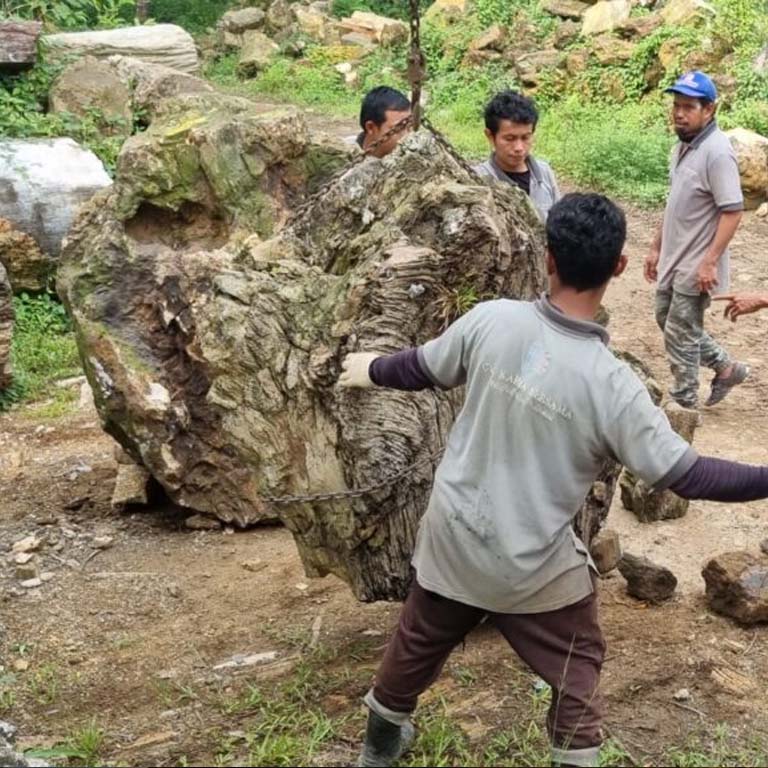
This is not a workshop.
It is an industrial fossil processing compound built to manage large-scale extraction intake, structural cutting, stabilization, polishing, and export preparation under one operational system.
Where many market participants operate from segmented subcontracted spaces, our compound integrates every stage of processing within a controlled environment designed for continuous output.Approximately 80 percent of total production is allocated to international markets, positioning the facility as a primary export engine rather than a domestic craft workshop.
Scale of Physical Infrastructure
The compound extends approximately:
• 222 meters in length
• 187 meters in width
Across this area, production is organized into multiple functional sectors to allow simultaneous heavy cutting, finishing, resin stabilization, drying, and packaging without workflow interference.
The facility includes:
• 10 dedicated production buildings
• 1 mechanical fabrication and maintenance building
• 1 large-format industrial cutting hall
• 2 mid-scale slab cutting buildings
• Separate resin stabilization zone
• Dedicated polishing hall
• Raw material yard
• Drying yard
• Waste management zone
• 2 warehouse structures
• 3 gallery buildings for finished inventory
Raw fossil logs are stored on-site year-round. This allows production scheduling independent of immediate extraction cycles, ensuring container-scale continuity.
Machinery Power and Large-Format Processing Capability
The core strength of CV. Karya Bersama lies not only in land size, but in mechanical capacity.
Petrified wood is not conventional timber. It is mineralized fossil material with quartz-like density. Processing it requires industrial-grade systems designed for stone, not wood.
Our cutting division operates:
• 7 industrial cutting machines
• Saw blades ranging from 600 mm to 2200 mm in diameter
• Water-cooled cutting systems engineered for structural preservation
The 2200 mm blade class places our facility within heavy fossil and stone processing category rather than artisanal fabrication scale.
Water-cooled diamond cutting reduces internal stress fractures during slab division. This is critical when processing fossil logs exceeding one meter in thickness.
Large-Format Log Processing
Our maximum log handling capability reaches approximately:
• 5 meters in diameter
• 1.5 meters in thickness
Slab cutting capability reaches:
• Up to 3 meters by 2 meters
• Large-format dining table surfaces approaching 5 meters in length
Few facilities in Indonesia maintain machinery capable of processing fossil logs at this scale.
Large-format processing allows us to produce:
• Oversized hospitality tables
• Architectural statement pieces
• Monolithic slab installations
• Custom commission projects exceeding standard furniture dimensions
This capability is not decorative. It is structural. It allows container-level export of high-value oversized units rather than limiting output to smaller retail items.
Multi-Machine Workflow
Large-scale processing does not rely on a single machine.
Our compound distributes cutting activity across:
• One dedicated large-format cutting hall
• Two mid-scale slab cutting buildings
• Specialized stool and smaller-format cutting stations
This distributed configuration prevents production bottlenecks and supports simultaneous execution of bulk slab processing and custom furniture fabrication.
While one division handles oversized slab segmentation, other divisions continue processing:
• Side tables
• Coffee tables
• Decorative objects
• Custom fabrication orders
This separation of scale operations allows stable weekly throughput rather than stop-and-start production cycles.
Finishing and Surface Engineering Capacity
Following structural cutting, surface finishing operations are conducted through:
• 20 polishing machines
• Dedicated resin stabilization facility
• Manual finishing stations for structural detailing
• 1 CNC machine for tile precision cutting
• 1 CNC system for spherical and specialty forms
Surface finishing can reach up to 3000-grit polish, depending on project requirements.
Resin stabilization is conducted in a dedicated zone rather than integrated within cutting areas. This separation ensures curing stability and environmental control during finishing stages.
The integration of CNC systems with manual finishing capability allows flexibility between architectural tile production and artistic furniture fabrication.
Continuous Multi-Shift Operation
The facility operates in multiple shifts, allowing:
• Extended daily machine operation
• Faster container scheduling
• Reduced idle machinery time
• Stable weekly output across product categories
Multi-shift operation is essential in fossil stone processing due to the density and time required for large-format cutting.
This operational rhythm supports:
• Approximately 150 slabs processed weekly
• Approximately 300 side tables processed weekly
• Approximately 20 dining tables completed weekly
Combined with finishing and packaging capacity, this throughput supports container-based export scheduling rather than sporadic shipment.
Container-Level Production Orientation
The facility is structured around export container logic, not single-item retail transactions.
Maximum historical output has reached:
• 5 × 20-foot containers within a single month
• 5 × 20-foot containers delivered within a single project cycle
Standard monthly operations typically support:
• 3 to 4 full container shipments
Container composition is weight-balanced due to fossil density. With 20-foot containers averaging 8 to 11 tons and 40-foot containers averaging 15 to 18 tons, shipment planning requires careful distribution across product dimensions.
This is not small-batch craft export.
It is industrial-scale container movement.
Inventory Depth and Raw Material Reserve
One of the defining advantages of the facility is on-site raw material storage.
Fossil logs are held year-round within the compound. This eliminates dependence on immediate extraction scheduling and protects production continuity during seasonal fluctuations.
Inventory depth allows:
• Immediate slab selection for custom projects
• Rapid container preparation when stock designs are requested
• Flexibility in color and density grading
• Reduced delay between order confirmation and cutting
Rather than sourcing per order, the facility operates from controlled stockpile management.
This stock stability reinforces export reliability.
Production Allocation: Global Orientation
Approximately 80 percent of total production is allocated to export markets.
This ratio reflects the facility’s structural design as an international supply base rather than a local showroom workshop.
Export markets served include:
• North America
• Europe
• Australia
• Japan
• Middle East
• Southeast Asia
The internal workflow, packaging standards, and inspection documentation processes are aligned with international shipment requirements rather than domestic retail expectations.
Integrated Export Preparation
Export preparation is not outsourced.
Crating, bracing, reinforcement, and container loading are conducted within the compound.
On-site export integration includes:
• Custom crate fabrication
• Styrofoam and internal support installation
• Weight distribution planning
• Container sealing documentation
• Photo and video recording of loading process
This integration reduces handling transfer points and minimizes transit risk.
By maintaining export preparation within the production compound, the company retains full operational oversight from slab cutting to container sealing.
Industrial Continuity Across Economic Cycles
Operating since 1983, CV. Karya Bersama has maintained production continuity through multiple global economic shifts.
Sustained throughput capacity across decades reflects:
• Stable workforce structure
• Long-term material sourcing networks
• Machinery reinvestment
• Export infrastructure familiarity
This continuity is a structural advantage in a sector where many small operators enter and exit during market fluctuations.
Structural Reinforcement and Engineering Control
Petrified wood, while mineralized and structurally dense, retains natural fractures formed during fossilization. Large-format slabs especially require careful structural assessment before finishing and export.
Within the CV. Karya Bersama compound, structural reinforcement is not improvised.
It is engineered.
Oversized dining tables and monolithic slabs undergo internal evaluation before final finishing. When necessary, steel reinforcement systems are fabricated within the on-site mechanical workshop and integrated directly into the slab structure.
This integration occurs before polishing, not after.
The objective is long-term structural stability during:
• Sea freight vibration
• Temperature variation
• Load-bearing installation in hospitality environments
Reinforcement is applied only when required by structural assessment, preserving material authenticity where possible.
Resin Stabilization and Fracture Management
Natural cracks are inherent to fossil material.
Rather than masking them indiscriminately, slabs are graded and categorized based on fracture depth and structural implication.
Within a dedicated resin stabilization zone:
• Structural cracks are filled and stabilized
• Surface fractures are treated according to aesthetic specification
• Curing is conducted under controlled conditions
This controlled environment prevents contamination of cutting areas and ensures consistent curing integrity.
The objective is not cosmetic perfection, but controlled stabilization that preserves the fossil’s geological identity while maintaining durability.
Internal Quality Control Systems
Industrial scale without inspection discipline creates risk.
Each production stage follows internal verification steps:
- Post-cut dimensional inspection
- Structural assessment review
- Surface finish verification
- Reinforcement validation where applicable
- Final inspection before crating
Measurement confirmation is conducted prior to packaging to ensure dimensional compliance for international shipment.
Container loading is documented through photo and video recording until sealing.
This documentation process provides transparency for international buyers and reduces post-shipment dispute risk.
Workforce Structure and Skill Continuity
The facility employs approximately 134 personnel across cutting, finishing, mechanical maintenance, logistics, and administration.
Skill continuity is central to fossil processing, as mineralized wood requires handling knowledge distinct from conventional timber or granite processing.
Machine operators are trained to manage blade pressure and cooling cycles appropriate for fossil density. Polishing teams understand the crystallization patterns that influence surface reflection.
Multi-shift operation supports throughput without compromising process supervision.
Operational continuity across decades has built cumulative expertise within the workforce.
Environmental and Land Responsibility
Extraction activities are conducted through contracted land networks.
The company engages local communities in extraction operations and maintains responsibility for post-extraction site management.
Land restoration practices are implemented following material removal.
An internal team oversees environmental responsibility and ensures extraction activities align with regulatory frameworks.
Although petrified wood is fossilized mineral material rather than harvested timber, responsible sourcing remains central to long-term operational legitimacy.
Long-Term Operational Discipline
Operating since 1983, CV. Karya Bersama has maintained continuous production through:
• Regulatory transitions
• Export framework changes
• Currency fluctuations
• International demand shifts
Longevity reflects structural discipline rather than opportunistic trading.
Machinery reinvestment, multi-zone compound development, and export integration have been built incrementally over decades.
This layered infrastructure is not rapidly assembled.
It is accumulated.
By the Numbers
Facility Scale
41,514 square meters industrial compound
222 m × 187 m production footprint
Production Infrastructure
10 production buildings
1 mechanical fabrication workshop
7 industrial cutting machines
20 polishing machines
2 CNC systems
Large-Format Capability
Maximum log diameter processed: up to 5 meters
Maximum slab dimension: up to 3 m × 2 m
Diamond blade range: 600 mm to 2200 mm
Weekly Throughput (Average)
150 slabs
300 side tables
20 dining tables
Container Capacity
Up to 5 × 20-foot containers in peak month
3–4 containers typical monthly export flow
Export Allocation
80 percent international markets
20 percent domestic distribution
Operational Continuity
Established 1983
Multi-shift production structure
On-site raw material inventory year-round